
PORTLAND — Raechel Allen remembers growing up, playing hockey and being the only girl on her co-ed team. There was the thrill of playing and being on the roster, met by the feeling of isolation that comes with being the only one.
“You’re in the locker room alone,” she said. “You’re not going in until the Zamboni’s on the ice 10 minutes before the game.”
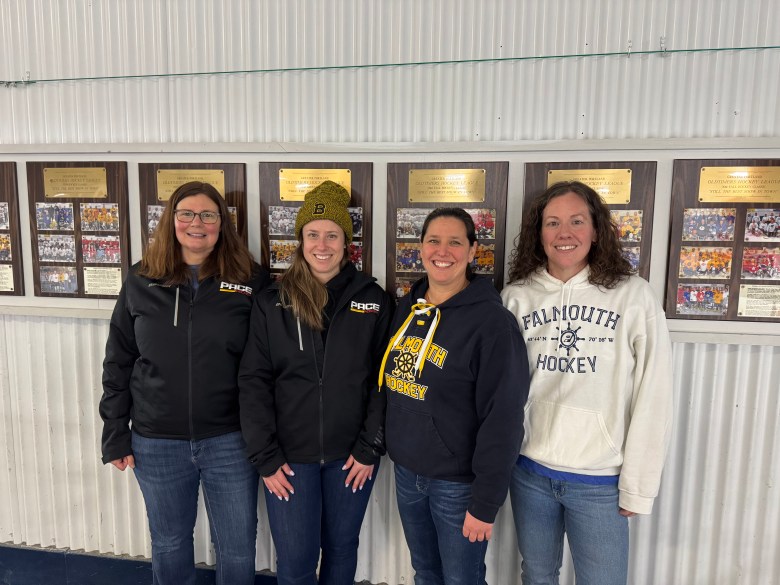
It’s why scenes like Monday’s Southern Maine Middle School Hockey Association championship game make her smile. Allen’s PACE (Portland and Cape Elizabeth) team met Marlene Scheuchzer’s Falmouth squad in a unique setting — a game played by girls, coached by women and officiated by women.
PACE won 4-1 behind four Pipi Hooper goals. But the score was only part of the story.
“This is a special moment because it’s showing girls leadership, for the girls that maybe would like to coach in the future or even the two female referees (Morgan Rochefort and Katherine Pate) that we (had) today,” Allen said. “The sport is growing. I believe that USA Hockey now has 100,000 girls and women signed up compared to, like, 28,000 in the late 1990s. This is showing them the possibility of having a positive role model on and off the ice.”
The moment wasn’t lost on Scheuchzer and assistant coach Lauren Guite on the other bench.
“The importance is to show the girls there’s opportunities for them,” Scheuchzer said. “Females are taking the leadership role as coaches behind the benches. I think that’s important for them to see.”
“It’s really cool that we’re having a moment right now,” Guite said. “I think it’s really important that people see this and get their little girls involved early. … There are resources out there. I’m hoping people are inspired, and listen to their little girls when they say ‘I want to play hockey.’”
Girls have had the opportunity to play for years, but it’s been tough erasing the notion that it’s chiefly a boys sport. Only two girls high school teams in Maine are coached by women (one has a woman among its two co-coaches). Even in the middle school league that had its championship game Monday, PACE and Falmouth are the only teams with women coaches.
But there are signs from the national to local level that the presence of women in hockey is becoming stronger. The United States women’s gold-medal run in the Olympics captivated the country. The Professional Women’s Hockey League is growing in popularity, with 50% increases in sponsorship and sales of merchandise doubling, according to an article in Sports Illustrated.
And locally, the Maine Amateur Hockey Association tabbed Louise Roy as the Maine girls director to oversee the girls game in the state, a position Marci Gagnon — one of the two PACE assistant coaches with Phil Kronenthal — said has previously been filled by men. It points to a trend of women showing up in more leadership positions in the sport, and Monday provided another example.
“Representation really matters,” Gagnon said. “When they look up and they can see all areas of Maine that are represented by female coaches and officials, as well as players on the ice, it really shows a deep passion for the sport. … It is a great opportunity for the foundation and the future of girls hockey in the state of Maine.”
The girls who took the ice were excited as well.
“That’s really cool,” Falmouth eighth-grader Roney Gregoire said. “I feel like it just shows how much women have improved in the sport.”
Eliza Bisogni, an eighth-grader from PACE, called having women coaching and officiating their game “awesome.”
“I’ve never had this happen, even with any of the games that I’ve played,” she said. “It’s really cool to see the sport evolve over time. … It makes a huge difference because it always feels like the men are in charge in a way. But now you’re like, ‘Oh, the women can do that, too.’”
Lindsey Scheuchzer, an eighth-grader with Falmouth, said she likes seeing more balance in what’s been a male-dominated sport.
“It’s really cool because we get to see different perspectives on the ice,” she said.
Gagnon said being able to see those perspectives resonates with players, and breakthroughs at the younger and local levels can lead to more participation.
“I think it matters to see female coaches and female referees, because it shows what’s possible and it makes the game feel like it belongs to everyone, not just boys,” she said. “You build the foundation and then years later, you have officials that come on the ice because they were part of the Portland Trust (youth program) or they were part of a team that supported them growing up.”