
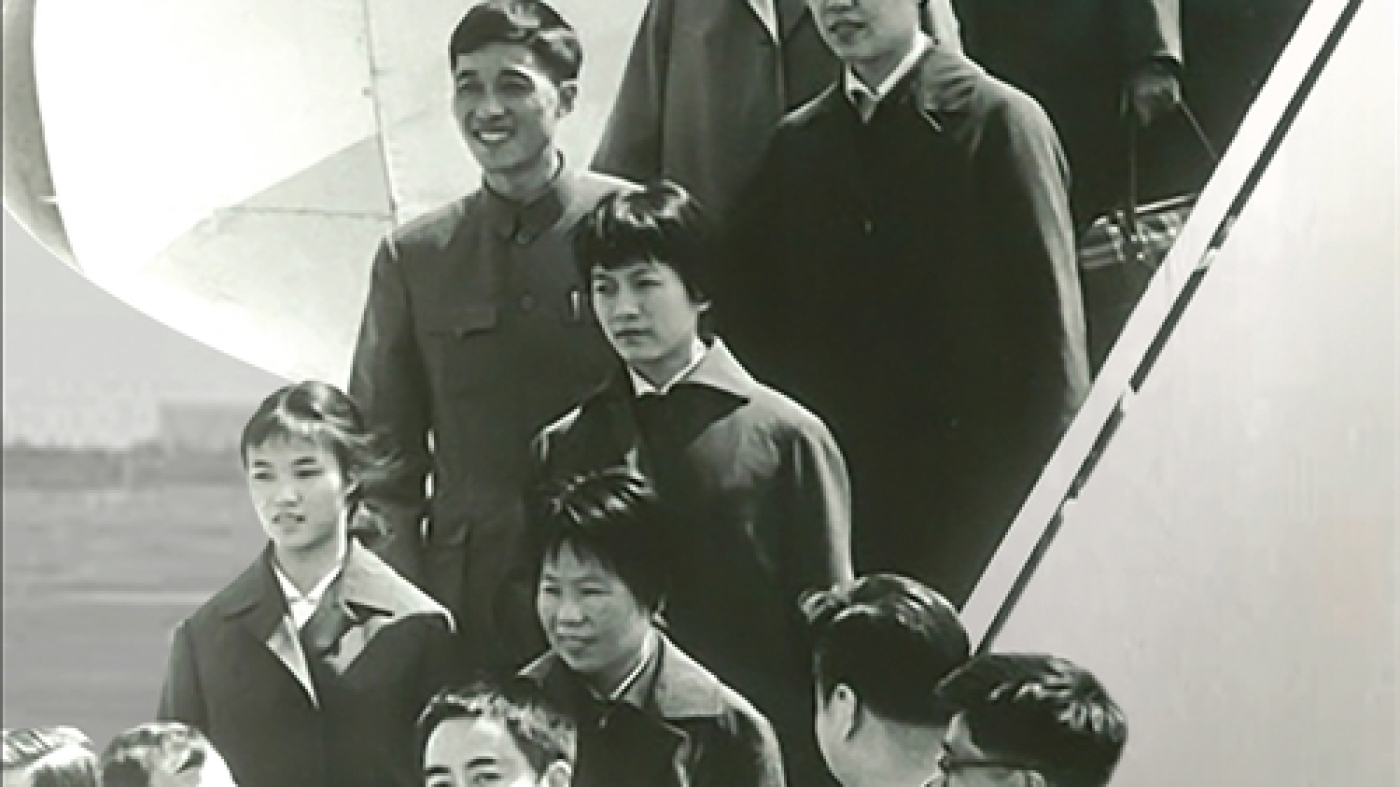
In March 2000, a package from the U.S. Congress arrived at Shanghai’s Fudan University. Inside was an American flag that had flown over the Capitol — sent as a gesture of appreciation for Xie Xide, the renowned Chinese scientist who had recently died. Xie had played a key role in fostering cultural and scientific exchanges between the two countries.
Stories like this are almost inconceivable today in both the United States and China, as the tone of their bilateral relations has fundamentally shifted. But in the new book, Chinese Encounters with America: Journeys That Shaped the Future of China, profiles of 12 Chinese individuals remind us of the optimism that once defined the two countries’ engagement. This optimism has faded away in recent years.
The dozen profiles in this edited volume highlight the positive aspects of U.S.-China exchange, which began in earnest after diplomatic relations were established in 1979. These accounts range from academics like Xie Xide, to environmental activists like Ma Tianjie, and diplomats like Ji Chaozhu, who served as an interpreter during President Richard Nixon’s historic visit to Beijing in 1972.
Today, as the U.S. and China find themselves in a period of intense competition, these stories may be interpreted differently, depending on the reader’s own views on the once-popular engagement policy. Nevertheless, they serve as a reminder of a unique chapter in bilateral relations, however brief it may have been.
The book’s co-editors, Deborah Davis — a leading sociologist on China — and Terry Lautz, author of Americans in China, argue that the book underscores the value of finding common ground. They express concern that both Americans and Chinese are losing sight of their shared interests and the benefits that have come from cooperation.
In an email exchange with NPR, the editors sent joint responses to questions about the issues addressed in the book. Here is an edited version of the exchange.
NPR: You said you were concerned that both Americans and Chinese had lost sight of their shared interests. Why, in your view, did this happen?
Davis and Lautz: China’s unexpected arrival as a major economic and military power triggered a downward spiral in the U.S.-China relations. Washington saw China’s ascent and its hardline diplomacy as a challenge to the existing world order. Beijing viewed the United States as a threat to its interests, especially the PRC’s claim to the island of Taiwan. This new power dynamic undermined the long-held assumption that Sino-American engagement would lead to positive, peaceful change. Instead, it produced a climate of fear and distrust. The aim of our book is to show the benefits of cooperation and mutual understanding despite our differences.
NPR: In short, how has encountering the U.S. changed these individuals — and China itself?
Davis and Lautz: The impact varies over time. Those who returned to an impoverished China during the Cold War faced different challenges and had different motives from those who returned in the 1990s or 2000s when China was more open politically and prosperous. The consequences of their encounters also vary by occupation — from education, dance, and diplomacy to civil society, science, and sports.
Their life stories are remarkable. For example, Xie Xide, a renowned physicist who received her PhD from MIT in 1951, became the first woman president of a major Chinese research university in 1983. But she also spent years cleaning floors during the Cultural Revolution. Wang Jisi, one of China’s most prominent America watchers, spent seven years herding sheep in Inner Mongolia during the Cultural Revolution before entering Peking University in 1978. Lang Ping, a Chinese sports icon, coached the U.S. women’s volleyball team to a silver medal at the Beijing 2008 Olympics, and then led China’s team to gold at the 2014 World Championships. Peng-Peng Gong was trained at the Juilliard School in New York but walked away from a lucrative career as an international concert pianist and returned to China as the resident composer of the Shanghai Philharmonic Orchestra in 2014. He calls himself