
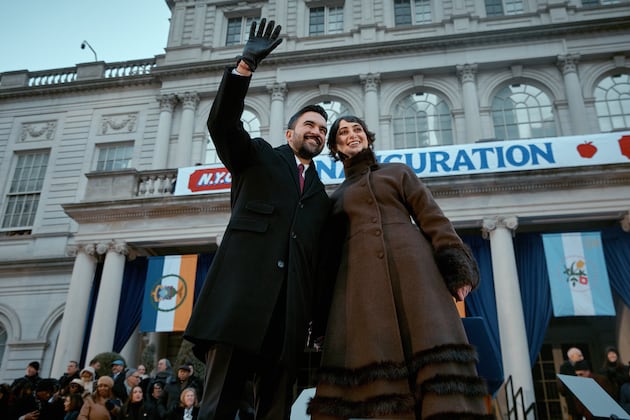
The inauguration of New York City’s new mayor, Zohran Mamdani, was a celebration of many historic firsts. At 34, Mamdani, a democratic socialist, is the first South Asian and African-born person to hold the office and the first Muslim mayor to lead New York City.
Mamdani’s Muslim faith was threaded throughout the inauguration, from a private ceremony early on Jan. 1 inside the long-closed City Hall subway station, where he laid his hand on a centuries-old Quran, to the larger public ceremony later in the day, where he also used family copies of the holy book — the ones that belonged to his grandfather and grandmother.
Mamdani was the first New York City mayor to be sworn in on the Quran during an inauguration. Sen. Bernie Sanders, I-Vt. administered the oath of office to Mamdani.
The daytime celebration featured a prayer by Imam Khalid Latif, who was joined on stage by faith leaders from across the city.
Other speakers highlighted both the significance of Mamdani’s faith and the diversity of religions within the city’s new administration.
“It’s immensely significant to have a Muslim in public office and especially in a public office as central as the mayor of New York is to the United States,” said Ismail Royer, director of Islam and religious freedom at the Religious Freedom Institute. “It’s very meaningful that we live in a country that does not have religious tests for office and that could have someone in public office who is a Muslim, a Jew, a Hindu, even an atheist.”
Especially significant is having a Muslim leading the city that was attacked in the 9/11 terrorist attacks, carried out by extremists claiming to act in the name of Islam.
Swearing on the Quran
On Jan. 1, shortly after the ball dropped in New York City, Mamdani stood beneath the arch of the old City Hall subway station and placed his hand on two copies of the Quran: one that belonged to his grandfather and a nearly 200-year-old copy borrowed from the New York Public Library.
The rare Quran on loan from the library was once owned by Arturo Schomburg, the Black historian and writer who sold his 4,000-volume personal library to the New York Public Library in 1926, a collection that later became the foundation of the Schomburg Center for Research in Black Culture. “The significance of this Qur’an extends far beyond the beauty of its pages,” said Hiba Abid, curator of Middle Eastern and Islamic Studies at the library, according to a statement on the library’s site.
“It is a Qur’an close to the people, not only because of its simple craftsmanship, but also because it is part of the collections of the nation’s largest public library system. Its importance lies not in luxury, but in accessibility, and we hope it inspires more New Yorkers to explore the rich diversity of our Middle Eastern and Islamic collections.” The library will put this copy of the Quran on public display starting Jan. 6.
While other mayors have traditionally used the Bible during oath-taking ceremonies, the law does not require officials to use any religious text.
Diversity of faiths
Speakers during the daytime ceremony at City Hall acknowledged the historic significance of Mamdani’s faith. “ Zohran Mamdani will be the first Muslim mayor of our great city. He’ll be our first immigrant mayor in over a century and he will be the youngest mayor of New York City in generations,” Rep. Alexandria Ocasio-Cortez, D-N.Y., said during the inauguration. “But most importantly, Zohran will be mayor for all of us.”
The ceremony also featured a fervent prayer by Imam Latif, who was joined on stage by faith leaders from across the city, including Rabbi Ellen Lippmann, the Rev. Andrew Wilkes, the Rev. Stephen A. Green, and others. “We gather today with heart shaped by this city, by its noise and its neighborhoods, by its subways and sanctuaries, by the dreams carried in many languages and the prayers whispered on crowded blocks,” Latif said in his prayer.
He expressed gratitude that New York City could be a place that “ has taught the world how difference can become strength” and “strangers can become neighbors,” and for being a city where “a socialist Muslim can be bold enough to run and brave enough to win.”
Latif noted in his prayer that “leadership is not about power, but about proximity to the people who struggle.” He thanked the organizers, volunteers, neighbors, young people, and elders who campaigned for Mamdani and asked God to help the new administration be “a means of mercy, a force for fairness and a reflection of your justice in this world.”
Mark Levine, who was sworn in as New York City comptroller, highlighted the city’s religious diversity in its leadership. “ How remarkable is it that on these steps today we have three swearings in: one by a leader using a Quran, one by a leader using a Christian Bible and one by a leader using a Humash or Hebrew Bible,” Levine said. “ I am proud to live in a city where this is possible.”
Victory despite anti-Muslim sentiments
In his inaugural address, which did not focus on questions of faith, he emphasized the city’s unity across class, race, religion, language, and political differences.
At the heart of Mamdani’s message was that New York should belong to everyone who lives there. “To live in New York, to love New York, is to know that we are the stewards of something without equal in our world,” Mamdani said. “Where else can you hear the sound of the steelpan, savor the smell of sancocho, and pay $9 for coffee on the same block? Where else could a Muslim kid like me grow up eating bagels and lox every Sunday?”
Throughout the campaign, Mamdani worked to build trust with both Jewish and Muslim voters by emphasizing shared concerns around safety, dignity and economic fairness.
He met frequently with synagogues, mosques and community organizations, listening to fears around antisemitism and Islamophobia and condemning both. Mamdani’s criticism of Israel, however, drew pushback from parts of New York City’s Jewish community, which is home to roughly 1.3 million Jews.
Royer argues that Mamdani’s election is significant not only because he won as a Muslim candidate, but because he prevailed despite a campaign that attempted to stoke anti-Muslim sentiment.
A conservative Muslim, Royer expressed concern that American politics often conflates Muslim identity with far-left politics, noting that most Muslim politicians align with progressive platforms, which does not fully reflect the community’s spectrum of beliefs.
“One of the most important messages is the magnanimity of the American people, and especially the people of New York,” Royer said. “It almost raises goosebumps on my skin when you think that Americans are not holding his faith against him — it says a lot about what it means to be an American, certainly what it means to be a New Yorker.”