
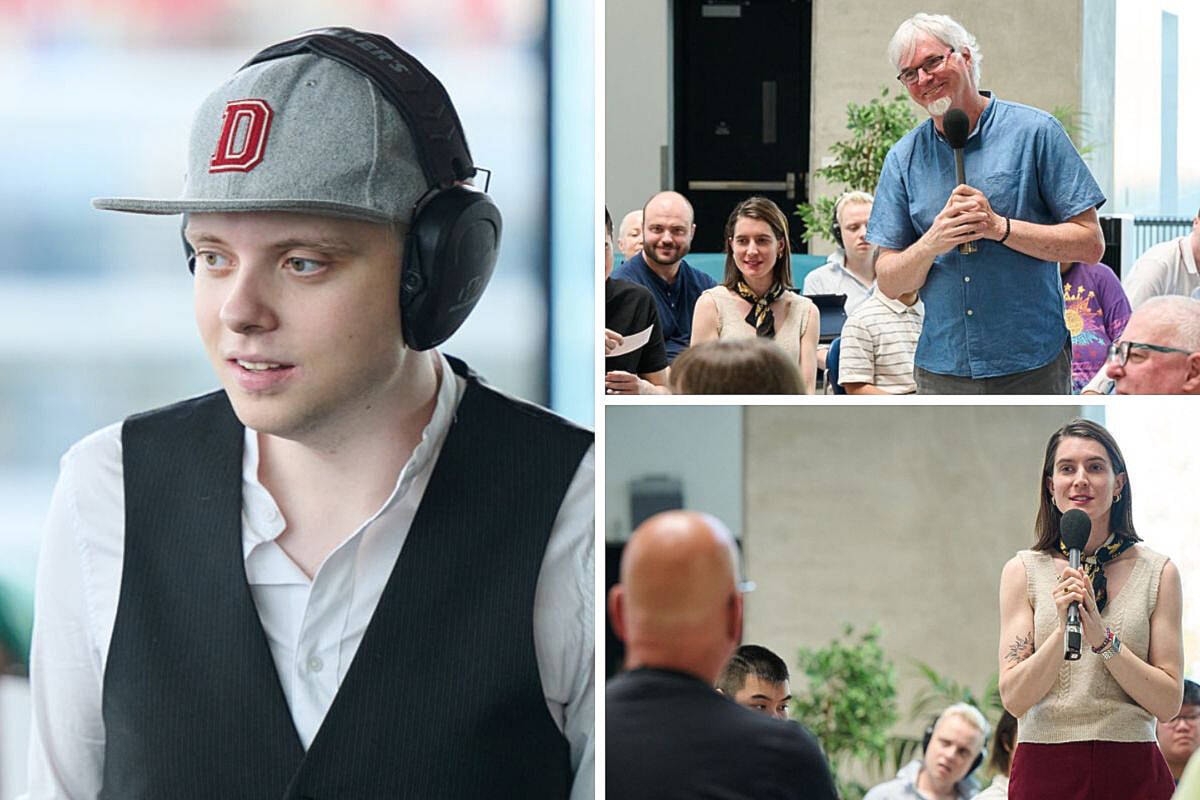
Three White Rock residents a part of the neurodiverse community are featured in Canada’s first season of The Assembly, which just launched on CBC.
The Assembly is CBC’s take on the Australian and United Kingdom documentary show that allows members of the neurodiverse and autism community to interview celebrities in any way that fits their comfort levels – and where nothing is barred.
Mariah Reitmeier, Bruce Petherick and Damon Kirsebom were offered the chance to be a part of this show and interview Canadian celebrities as part of a panel.
“This show gives us a platform to help raise awareness for autism and those in the neurodiverse community,” Reitmeier says when asked about her experience on the show. “It was nothing but a surreal experience, and it opened up new opportunities for us as individuals on the autism spectrum.”
Reitmeier found out about the opportunity when she was messaged on Facebook via Messenger by one of the producers. The casting producer mentioned the series to her and asked if she would be interested to join the cast.
Reitmeier jumped on the opportunity and got the chance to interview four out of the six guests for this season.
Season 1 of The Assembly features Howie Mandel, Maitreyi Ramakrishnan, Jann Arden, Arlene Dickson, Allan Hawco and Russell Peters.
Kirsebom got to interview five out of the six and Petherick two.
“I was actually so nervous when I was getting ready to pose my questions to each of the Canadian celebrities,” explains Kirsebom. “I was trembling inside, and had to remind myself to slow down, breathe, and enjoy the moment. Each of the celebrities I interviewed was warmer than I had anticipated, and they answered my questions in thoughtful ways.”
Kirsebom shares that he really believed that the celebrities enjoyed this process and were open with him and the other interviewers.
Kirsebom is a non-speaking, autistic university student born and raised in South Surrey. Until he was 14, Kirsebom had no way to reliably communicate with anyone. He now uses an iPad with a voice output app in order to type whatever he is thinking.
Kirsebom used this output app while interviewing. “As a non-speaking individual, it is often assumed that I don’t understand the world around me; so I loved being able to demonstrate that I do understand and that I have something to say,” he shares.
Kirsebom, Reitmeier and Petherick all mention how good it felt to be surrounded by other community members who understood and could relate one way or another.
“It was a good experience. I was fortunate not to know anybody so that was interesting coming in and meeting people who knew each other, and I didn’t even know the celebrities besides one,” Petherick admits before sharing how interesting it was to sit back and observe these interviewers prior to filming.
“We all have to mask, and the ability for us to communicate unmasked needs a lot of preparation, and you saw it in the green room. Some were more obvious than others,” Petherick says before leading into this idea he pitched to the producers after filming about a behind-the-scenes type show, a show within a show.
As someone that is neurodivergent and an autism advocate, Petherick wants their voices to be heard.
“Too often our representation has been neurotypical. I always say it’s time for us to share our own stories. The show allowed that perspective to happen and has normalized it.”
“Opportunities like The Assembly are valuable,” Kirsebom shares. “There is so much misunderstanding around what it means to be autistic, and it really is time that we tell our own stories.”
“What really matters is representation,” Reitmeier says, continuing the group consensus. “Being a part of this series makes me feel proud to represent the autism community.”
These three White Rock residents all say they’d be more than happy to participate in future seasons of this show and share that all the interviewers from the first season still keep in contact with one another via group chats.
Reitmeier, Petherick and Kirsebom are looking forward to the rest of the season to air on CBC and hope that people see the importance of their representation through this show.