
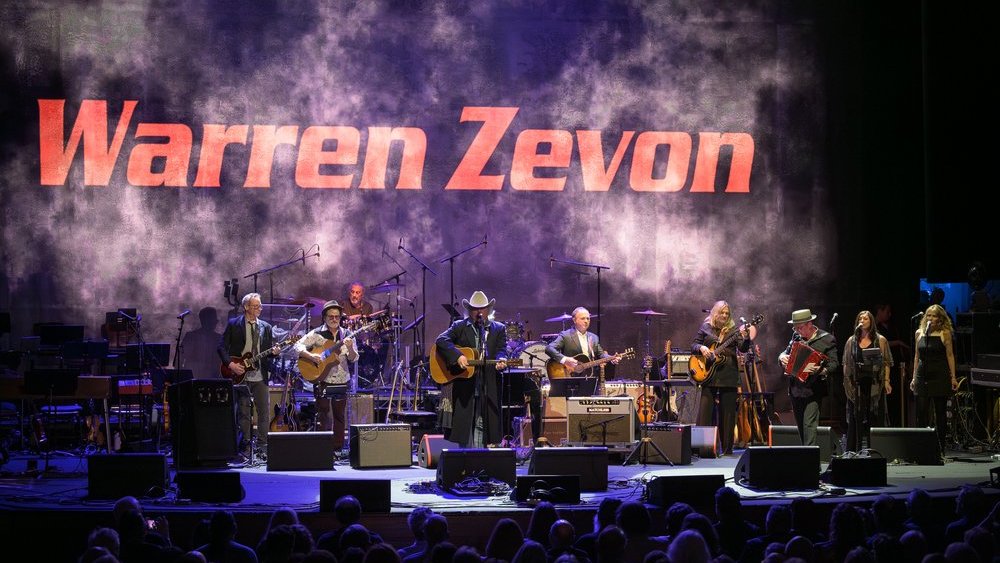
What does it say that a Warren Zevon tribute concert Friday night featured more than 30 songs, was performed by well over 50 musicians, and stretched nearly to four hours in the end … and still felt skimpy? It says that some of us are just a little too greedy, 22 years after the honoree’s death, to hear as many of the rock genius’s greatest songs performed as possible, even if that really would entail playing it all night long. Given that no one involved could really wait till they’re dead to sleep, anyway, the Wild Honey organization put on the most complete tribute imaginable, squeezing a catalog full of wicked humor and warmth for all the tearjerking and titter-prompting it was worth.
The Wild Honey Foundation typically puts on one of these tribute shows a year to benefit autism causes, and usually, apart from the honored artist himself (if he’s alive and kicking), it’s a one-song-per-frontman affair. Things were just a little different Friday at the United Theater in downtown L.A. (the first time one of these shows has taken place in that movie palace, after a long run at the smaller Alex in Glendale). A handful of family members or associates got to play a few more numbers each than the standard one-and-done, including Jackson Browne, who produced Zevon’s first two albums and has remained an enthusiastic champion ever since; Jorge Calderón, who collaborated as a writer and/or performer on all of Zevon’s albums except one; and Jordan Zevon, his son. Although he never met Zevon, Shooter Jennings also got the special privilege of playing two songs instead of just one, and he’d earned it: the guy has done repeated Zevon tribute concerts on his own and even released a live album of Zevon covers.
Apart from these artists with obviously deep connections, the lineup was led by Dwight Yoakam, who did a highly regarded cover of “Carmelita” back in the early ’90s (in collaboration at the time with Flaco Jimenez), and such artists as Steve Wynn, the semi-reunited Fountains of Wayne, Chris Stills, John Wesley Hardig, Adam Weiner of Low Cut Connie and other guest from the east coast as well as Warren’s favored west.
It was “Jordan Strikes Up the Band” as the son rose to kick off the long evening with a vocally familiar-sounding rendition of the “Johnny” song that started off “Excitable Boy,” the 1978 album that was Dad’s commercial peak. Soon following was a singer with another connection to Zevon Sr., Matt Carsonis, who played with the honoree on the final dates he did in 2002, just prior to learning he had only months to live; his contribution was to dip into the all-too-truncated 21st century portion of Zevon’s with “Dirty Life and Times.” (Carsonis is involved in the forthcoming release of a live album that will present Zevon’s final concert on disc for the first time, for Record Store Day Black Friday .)
“Roland the Headless Thompson Gunner,” possibly Zevon’s most violent song, as a Sam Peckinpah/Ichabod Crane hybrid, was a ladies’ choice selection, with Living Sisters Inara George and Eleni Mandell cheerfully facing each other down as they sang “…talkin’ about the man.” The rural-dystopia number “Play It All Night Long,” meanwhile, had Dream Syndicator Steve Wynn reprising the song of Zevon’s that invokes the most bodily fluids… besides blood. (But also blood.) “Anybody who could write ‘Little old lady got mutilated late last night’…,” praised Wynn. “But I’m not doing that one. I decided to do the song where he says brucellosis.”
The most obscure songs of the night came midway through the first act, with two selections recorded and/or written by Zevon in the 1960s, roughly a decade before his solo career as a major-label artist took off. (For a few rocking minutes, the audience could well have been back at the “Nuggets” show Wild Honey put on in 2023.) First up in that extremely retro vein were Steve Stanley and Kristi Callan, covering “Follow Me,” a folk-psych-rock song Zevon cut as a member of the high-school duo Lyme & Cybelle. It hit No. 65 on the Hot 100 in 1966. Who knew? Well, probably a sizable portion of the cult. Then followed “Outside Chance,” a number Zevon co-wrote for his labelmates the Turtles that same year, described by the evening’s host, Chris Morris, as “a Byrds-style ripper.” This one was done by the Smithereens’ Dennis Diken, with support from Scott McCaughey and, on guitar, the Beach Boys’ David Marks. While you couldn’t exactly say that Zevon’s writing style was fully in bloom by 1966, there was an early foreshadowing of his wit, as Diken bellowed: “You don’t stand an outside chance… BUT YOU CAN TRY!”
Low Cut Connie mainstay Adam Weiner proved a great choice for the tribute, as one of the few frontmen in rock after Zevon whose main instrument is an enthusiastically pounded piano. “I call him the piano fighter… I’ll be singing the truth right now,” Weiner promised, launching into a latter-day Zevon favorite, the short, not-so-sweet “My Shit’s Fucked Up.”
Fountains of Wayne, recently relaunched by Chris Collingwood, and augmented here by both perennial members and ringers, got the keys to Zevon’s most covered tune, “Poor Poor Pitiful Me.” (The appearance was all too short for those of us who have clamored to see this summer’s very short reunion tour extend to the west coast; no sign of that yet, so let’s hope this was not the last local performance under the FoW name.)
Zevon creative BFF Jorge Calderón followed, saying, “As you may well know, me and Warren were very close friends for a long time and partners in many a crime, and the best crimes were our song collaborations” — going into the first three of four co-writes with Zevon he would do during the evening. He told a similar story about co-authoring the Woodrow Wilson-era anti-imperialist lament “Veracruz” as he told to Variety earlier in the week (check out that concert preview story here). Calderón has said the best attribute he and Zevon shared as writers was a penchant for as much economy in lyrics as possible., Yet the exception to that was the late-period “Mr. Bad Example,” which in a fit of hysteria in their writing den (seated together on the “Couch of Pain”) ultimately resulted for once in as many verses possible, all of them, by Calderón’s own account, “ridiculous.”
Shooter Jennings knows how to do roughhouse rock — as well as being, like Weiner, another piano man — and he was just the man for the gleeful psychosis of “Excitable Boy” and the no-sleep-till-Valhalla anthem “I’ll Sleep When I’m Dead.” He was followed by the closer for Act 1, Yoakam, tipping his hat to “Carmelita” with a reprise of his Cali-Tex-Mex cover, and ensuring that heroin abuse never sounded any more winsome (or Pioneer Chicken any sweeter, for that matter).
Act 2 began with Browne’s first of two appearances, singing the unduly prophetic “Don’t Let Us Get Sick,” Zevon’s moving prayer to a possibly unhearing deity for health of every physical and mental kind. The ensemble’s substantial string section handled the potentially rough segue from that to the rowdier next song with one of three “Interludes” they played over the course of the night, lifted from the appearances of interstitial orchestration on the “Bad Luck Streak in Dancing School” album. And then came the jammiest number of the program, “Nighttime in the Switching Yard,” a funk-rock exercise that allowed plenty of room for Chris Stills to not just sing but play guitar hero.
As a personal aside, I’d spent the entire show thus far worried about who the Wild Honey gods would deem worthy of handling “Accidentally Like a Martyr,” the “Excitable Boy” ballad that is my favorite piece out of the entire Zevon oeuvre, and, if you’ll indulge just a little possible exaggeration, maybe the saddest song ever written. (Suffice it to say that this song, a recent breakup or loss and razor blades should not be allowed within 50 yards of one another.) My anxiety could not have been more unfounded. It went to Billy Valentine, who performed with a sibling as the Valentine Brothers in the late ’70s and ’80s, and who has enjoyed a recent renaissance with fresh solo material. He nailed “Martyr” with a full soul vocal that some attendees may remember for the rest of their lives. Music directors Jordan Summers and Nick Vincent did a classic song that passes too quickly on record a great service by extending it by a few choruses, giving Valentine a chance to wring the emotion out of it that was only inherent in Zevon’s necessarily simpler delivery. They also handing him a key change that was not on the record to turn it into a true power ballad. (Turning the piano part between verses into an orchestral part also ramped up the drama.) Over the course of four hours, the full house at the United was pacing itself by pretty much enjoying the show from the comfort of the seats… but for Valentine’s act of generosity, everyone was on their feet. Not-so-accidentally like a show-stopper, etc.
“Somebody had to follow Billy Valentine,” said Phil Cody, who was up next with what at least counted as another sad one, “Splendid Isolation.” “I guess the way to counter that,” he said, “is ‘We’ll bring the hillbilly stoner.’” Part of his way of taking it yokel — besides bringing in Foo Fighter Rami Jaffee on accordion and Willie Aron blowing harmonica — was to add a previously unheard yodel to the chorus. (Although Zevon himself was not above a yodel; see “The Hula Hula Boys,” the number I was sorriest to see not make the setlist, with the possible exception of “Hasten Down the Wind.”)
Susan Cowsill was introduced by Morris as someone who could rival Linda Ronstadt, and in fact it turned out that she released a cover of “Mohammed’s Radio” in 1976, more than two years before Ronstadt famously did it, although no one is holding Linda’s tardiness there against her. Just shy of 50 years later, she was still up to it. McCaughey, rather than Browne, took the rare Zevon/Browne co-write “Tenderness on the Block,” a reminder that Zevon could be a sentimental fool before he was exploring sentimental hygiene.
The most curious departure of the night — and a rewarding one — came when Jordan Zevon introduced an odd hybrid version of “Monkey Wash, Donkey Rinse” by suggesting that he was going to finally right a sort of sin committed by his father. He spoke about how he encouraged his dad to employ more organic-sounding arrangements later in his career, when the legend was favoring rough electronics in the late ’80s and ’90s, not to everyone’s enjoyment. “I used to kind of complain that they were almost demo-sounding, with lots of synthesizers, which ’70s kids, myself and Jordan Summers, rejected. … I tell ‘Dad, ‘You know, I got friends that would die to play with you.’ ‘You know, Johnny, I can’t afford a band.’ ‘Afford? They’ll play with you (for free!)’ ‘Johnny, maybe we should move on.’ I’m sure it was because he was his kid. He didn’t trust — he’d seen Jordan and I play at Madame Wong’s when we were 16, and we were not awful, but giving it our best…”
But now, stretching hands across the grave, Jordan was determined to have his pals pick up acoustic instruments — including fiddle and washboard — and give one of his synth-y songs from 1995’s “Mutineer” an organic arrangement at last. “We’re gonna do a little posthumous ‘I told you so.’ And hopefully in the afterlife, I’ll be all right,” Jordan quipped, before the band launched into a nearly zydeco-sounding rendition of “Monkey Wash, Donkey Rinse” — with Warren’s own lead vocal piped in over it on the PA. It was a bold move, but a jubilant one, and lightning did not strike the United Theater.
That, frankly, could have served as the sentimental finale of the night, but there was more to come in the 11:00 hour from two returning performers. Browne sang the irreverent but pointed “Life’ll Kill Ya” and what many aficionados consider to be Zevon’s true signature song, “Desperados Under the Eaves.” The orchestra was at full blast and the full vocal chorus was wailing “Look away, down Gower Avenue,” as if this were L.A.’s own “Dixie,” which of course it is.
That could have been the finale, but among soloists, at least, that slot was reserved for Calderón, who closed out the pre-group-sing portion of the show with Zevon’s biggest weeper, “Keep Me in Your Heart.” Calderón again told the story of his close and thorough collaboration with the legend on his final album, “The Wind,” which they actually started and finished right after Zevon’s diagnosis that he had only a few months to go — he actually made it for a year — and how the process of record-making, in his view, gave Zevon a little extra time on earth.
From there, there was only one place to go: up, and to the drawing of blood. The full cast assembled for “Werewolves of London” and “Lawyers, Guns and Money,” with ongoing Wild Honey producer mainstays Paul Rock, David Jenkins and Michael Ackerman able to join in amid what seemed more like a cast of hundreds than mere dozens.
After this, Zevon’s actual Rock and Roll Hall of Fame induction down the street in a couple of weeks may seem anticlimactic to anyone who was at the United for the more epic experience. With any luck, the short tribute the starry cast is able to squeeze into that long program will do him and his most famous songs justice, even if inevitably won’t offer the same gratifying sense of how fucked up his shit was.
Setlist for “Warren Zevon: Join Me in L.A.” concert at the United Theater, Oct. 24, 2025:
Set 1
Johnny Strikes Up the Band — Jordan Zevon
Join Me in L.A. — All Day Sucker
Dirty Life and Times — Matt Carsonis
Reconsider Me — John Wesley Harding (with Nelson Bragg)
Roland the Headless Thompson Gunner — Inara George and Eleni Mandell
(Interlude 1 — strings)
Play It All Night Long — Steve Wynn
Mutineer — Leslie Mendelson
Follow Me — Steve Stanley and Kristi Callan
Outside Chance — Dennis Diken (with Scott McCaughey and David Marks)
My Shit’s Fucked Up — Adam Weiner
Poor Poor Pitiful Me — Fountains of Wayne
Veracruz — Jorge Calderón
Mr. Bad Example — Jorge Calderón
Disorder in the House — Jorge Calderón
Excitable Boy — Shooter Jennings
I’ll Sleep When I’m Dead — Shooter Jennings
Carmelita — Dwight Yoakam